What to Take Before Meals: A Practical Guide to Pre-Meal Habits That Actually Stick
A practical look at pre-meal habits, the science behind them, and how to make one stick.
of supplement users say supplements are essential to maintaining their health.
Source: CRN 2024 Consumer Survey
the Reducose® dose studied in three peer-reviewed RCTs for post-meal glucose response.
Source: Lown 2017, Thondre 2021, 2024
the IOM Adequate Intake range for chromium in adults.
Source: Institute of Medicine, 2001
The most practical options to take before meals are water, a fiber supplement, apple cider vinegar, a pre-meal capsule, or an oral dissolving strip formulated with clinically studied ingredients. For people focused on post-meal glucose support specifically, the ingredient with the strongest clinical record is Reducose® — a patented white mulberry leaf extract studied in three peer-reviewed randomized controlled trials at the 250 mcg dose. Which format you choose matters less than which one you'll actually keep taking.
Most pre-meal routines die on a Wednesday.
Not because the idea was wrong, and not because the person didn't care. They die because the routine asked too much. A capsule needs water. A powder needs a shaker, counter space, and sometimes a clean spoon you can't find. Apple cider vinegar needs a glass and the willingness to drink something that tastes like punishment.
By the third or fourth day, the routine is gone. The bottle's still there. Just unopened.
A pre-meal habit can be almost anything you do before you eat. Water. Fiber. A spoonful of vinegar. A capsule. One of the newer dissolvable strips designed for the moment right before food shows up. Which one matters less than people think? What matters is whether the habit survives a real week, the kind that includes a delayed flight, a dinner out, and a Tuesday morning where everything happens at the same time.
This guide walks through what people actually take before meals, what the research says about it, the ingredients with serious clinical backing, and how to build a pre-meal routine that doesn't fall apart by Friday.
Why does what you take before meals matter?
Most nutrition advice glosses right over timing. The conversation lives at the food itself: what's on the plate, how it's cooked, whether the carbs are simple or complex. Almost nothing gets said about the few minutes before the first bite, even though those few minutes shape how the body actually handles what comes next.
Pre-meal habits work in two different ways, and it's worth keeping them straight.
The first is preparatory. Drinking water before a meal hydrates the digestive tract and sometimes helps with portion sense. Adding fiber before carbohydrates slows the speed at which the meal breaks down. Taking certain ingredients can help support the body's natural post-meal response. Small mechanical things, in other words, that make the meal go down a little smoother.
The second is psychological, and it gets dismissed more often than it should. A small ritual before a meal is an anchor. It tells the body and the brain that food is coming. It carves out a moment of intention in a day that mostly doesn't have any. People who eat in the car between meetings rarely have a pre-meal anything. People who pause for thirty seconds, even briefly, tend to develop a different relationship with food over months and years.
Neither effect is dramatic. Both are real. The popular version of pre-meal advice tends to skip the modest, well-supported effects in favor of the loud, overstated ones, which is part of why so many people land here suspicious of the whole category.
What do most people take before meals?
The answer is messier than the wellness internet suggests. Pre-meal habits, as they actually exist in real homes, fall into roughly five buckets:
- A glass of water, often warm or with a squeeze of lemon. Free. Easy. Usually, where people start.
- A fiber supplement, normally psyllium or inulin, is mixed into a small amount of liquid right before eating.
- Apple cider vinegar, either diluted in water or taken straight as a small shot. An old habit, passed around for generations.
- A pre-meal capsule, formulated as part of a routine around digestion and post-meal balance.
- A pre-meal strip, the newest format on the shelf, is designed to dissolve on the tongue in seconds with no water and no prep at all.
Each one has a place. Each one also has friction. The interesting question isn't "which is best in the abstract" but "which one is a real person actually going to do, every day, for months." Those are different questions, and they have different answers.

| Pre-meal option | Approximate time to take |
|---|---|
| A glass of water | ~50 seconds |
| Fiber (psyllium, inulin) | ~165 seconds |
| Apple cider vinegar | ~90 seconds |
| Pre-meal capsule | ~90 seconds |
| Pre-meal strip | ~10 seconds |
Figure 1. Time required for each pre-meal option from start to finish. Strips finish in seconds.
What is the best time to take supplements, before or after meals?
Honest answer: It depends on the supplement.
Some are made to be taken with food, often because the active ingredient absorbs better when there's some dietary fat in the system. Fat-soluble vitamins live in this category. Vitamin D, K, A, and E. So do most omega-3 fish oils. Pop these with breakfast or dinner, and you're fine.
Others are designed for use before food. The point is to support digestion, or the body's response to whatever's coming next. Pre-meal supplements are usually taken within a few minutes of eating. Not hours ahead, which is a common mistake. Glucose support ingredients are the most-studied example here.
A smaller group works best on an empty stomach, away from food entirely. Probiotics often go here, depending on the strain. Iron, too, since it binds with food compounds and absorbs less efficiently when you take it with a meal.
Always check the label before adding anything new. The general rule for pre-meal supplements: take them close enough to the meal to be useful. A capsule that needs water and prep is harder to time well than a strip that takes ten seconds.
What should you take before a carb-heavy meal?
Carb-heavy meals are where pre-meal routines either prove their worth or completely disappear. Pasta dinners. Weekend brunches. The basket of bread that arrives before the entrée. Restaurant rice bowls big enough to feed two people. The body processes carbohydrates faster than it does protein or fat, and the post-meal response tends to be more pronounced.
For people who want to support a healthy post-meal glucose response, a handful of ingredients show up again and again:
- Fiber, taken before the meal, slows the rate at which carbohydrates break down.
- Apple cider vinegar, used as a traditional digestive support, often paired with carb-forward meals.
- Cinnamon, mostly culinary but with some early research worth keeping an eye on.
- White mulberry leaf extract, particularly the patented Reducose® form, studied in three peer-reviewed randomized controlled trials specifically for its effect on post-meal glucose and insulin response.
- Chromium, an essential trace mineral with a recognized role in normal carbohydrate metabolism.
The two with the strongest clinical evidence are mulberry leaf extract and chromium. Both are covered in more detail below.
Across all three peer-reviewed trials, the 250 mg Reducose® dose significantly reduced post-meal glucose and insulin response with no meaningful difference from placebo in gastrointestinal tolerability.
— Summary of Lown 2017, Thondre 2021, and Thondre 2024
Why do some people focus on glucose metabolism support before meals
This is where pre-meal habits move from general wellness into something more specific. Over the last five years or so, a few things converged. Continuous glucose monitors went from medical devices to wellness tech. Books like Glucose Revolution by Jessie Inchauspé hit bestseller lists. Suddenly a lot of healthy adults were paying attention to what happens after meals, particularly the carb-heavy ones.
The basic biology, in plain language: when you eat, the carbohydrates break down into glucose. Glucose is the body's most immediate fuel. It enters the bloodstream within minutes, the body responds by releasing insulin, and the insulin moves the glucose into cells where it's used for energy or stored for later. The whole sequence is called carbohydrate metabolism, and it happens every time anyone eats anything.
What varies, meal to meal and person to person, is the pace. A meal that's heavy on refined carbs and light on fiber tends to produce a faster, sharper response. A meal balanced with protein, fat, and fiber tends to produce a slower, more gradual one. Neither is automatically better. The body just runs more steadily when the response is gradual.
Pre-meal supplementation, in this context, is about supporting that steadier response. Not preventing anything. Not controlling anything. Giving the body's normal carbohydrate metabolism a small assist, basically.
This is exactly the use case where one of the most clinically studied pre-meal ingredients on the market actually has serious research behind it.
What is Reducose® and what does the research show?
Reducose® is a patented water extract of white mulberry leaf, made by Phynova Group Limited in the UK. White mulberry, Morus alba if you want the botanical name, has been used in traditional medicine systems for centuries, particularly across East Asia. What separates Reducose® from the generic mulberry leaf extract you'll see on Amazon is one word: standardization. The Reducose® extract is standardized to 4.5% to 5.5% 1-deoxynojirimycin (DNJ) by HPLC. DNJ is the bioactive compound doing the actual work on carbohydrate metabolism.
Here's how the mechanism works, and it's worth understanding because it's a textbook case of why ingredient form matters more than ingredient name. DNJ inhibits alpha-glucosidase, an enzyme in the small intestine that breaks complex carbohydrates down into absorbable glucose. By slowing that breakdown, Reducose® supports a more gradual release of glucose into the bloodstream after a carbohydrate-containing meal. The action happens entirely in the digestive tract. Nothing crosses into the bloodstream until the carbs are processed normally.
Three peer-reviewed randomized controlled trials have studied Reducose® at the 250 mcg dose, and the results are unusually consistent for a category often plagued by inconsistent science:
- Lown et al. (2017) in PLoS One. A dose-response study in 37 healthy adults at Oxford Brookes University. The 250 mg dose significantly reduced post-meal glucose response after a carbohydrate challenge, with a clear dose-response curve.
- Thondre et al. (2021) in Nutrition & Metabolism. A randomized, double-blind, crossover trial in 36 healthy adults. The 250 mg dose significantly reduced glucose and insulin response to a sucrose challenge.
- Thondre et al. (2024) in Nutrients. The REDUCE study was a four-arm dose-ranging trial in 37 healthy adults. All three doses tested (200 mg, 225 mg, 250 mg) significantly reduced post-meal glucose and insulin response after a complex mixed-macronutrient meal.

Figure 2. Post-meal glucose response with and without pre-meal supplementation, based on the pattern reported across the Lown 2017, Thondre 2021, and Thondre 2024 trials.
| Condition | Post-meal glucose response pattern |
|---|---|
| Typical response | Sharp, rapid rise after the meal |
| With pre-meal supplementation | More gradual rise, based on the pattern reported across the Lown 2017, Thondre 2021, and Thondre 2024 trials |
Across all three studies, Reducose® was well tolerated. No serious adverse events. The dose-response trial specifically assessed gastrointestinal tolerability and found no meaningful differences from placebo.
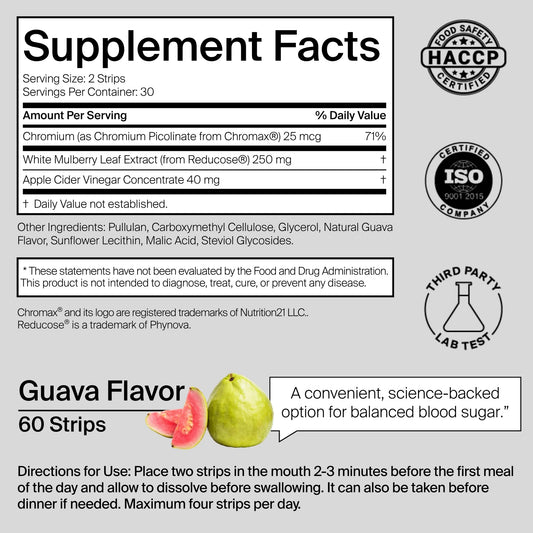
For people building a pre-meal routine around these ingredients, BIOSTRIPS® Glucose Support is the formulation to know. It contains the 250 mg Reducose® dose studied across all three trials, paired with Chromax® chromium picolinate and apple cider vinegar, in a sugar-free oral dissolving strip that takes ten seconds before any meal. The dose match between the product and the clinical research is exactly the distinction the next section covers.
The thing that sets Reducose® apart in the broader supplement category is something most consumers never check: the dose. A formulation using 50 mg of mulberry leaf extract is not the same product as one using 250 mg, even if the front of the bottle looks identical. The 250 mg dose is the one studied in three peer-reviewed trials. The formulations that match it are the ones with direct clinical substantiation behind their claims. The ones that don't match it are basically guessing.
What does chromium do in supplements?
Chromium is an essential trace mineral. Your body needs small amounts of it, gets most of what it needs from food, and uses it in normal carbohydrate, protein, and fat metabolism. The Institute of Medicine sets the Adequate Intake range for adults at 25 to 35 micrograms per day, which isn't much. Trace, as the name suggests.
In supplement form, chromium most often shows up as chromium picolinate. The picolinate version is more bioavailable than the alternatives, meaning the body absorbs it more efficiently. Chromax®, made by Nutrition 21, is the most clinically studied branded chromium picolinate on the market, with a long history of use in glucose support formulations.
At nutritional support levels, chromium contributes to the daily intake of an essential trace mineral with a recognized role in carbohydrate metabolism. At higher research doses, chromium picolinate has been studied for additional metabolic effects, but those higher doses sit well outside the standard nutritional range and are typically used in clinical research rather than consumer products.
What about apple cider vinegar?
Apple cider vinegar has been used as a traditional digestive support ingredient for generations, well before any of this had a marketing budget. The active component is acetic acid, the same compound that gives all vinegar its characteristic sharpness. In research, ACV is most often studied in liquid form at doses of 15 to 30 milliliters before meals, which is a tablespoon or two.
In supplement formulations, apple cider vinegar usually appears in smaller amounts, more as a complementary ingredient than a primary clinical-dose active. Its role is more about traditional support and digestive context than a standalone substantiation case. ACV still adds value to a formulation. The strongest claims in any pre-meal supplement, though, tend to come from the other actives, with ACV playing a supporting role in the background.
Why most pre-meal routines fail by week two
The supplement is rarely the problem. The format is.
Pre-meal supplementation only works when it's taken before meals, not occasionally, not on the organized days, but consistently. Before the restaurant dinner. Before the desk lunch. Before the meal at someone else's house. Before the travel day where the schedule falls apart.
That's where most capsule and powder routines quietly stop. Not on day one, but around day eleven, when the glass of water isn't in arm's reach and the shaker isn't in the bag.
Habit formation research is consistent on this: new behaviors that require more than two minutes to execute, depend on specific equipment, or can't be replicated across changing environments don't last. Pre-meal supplementation is exactly the kind of habit that gets disrupted by a slightly different Tuesday.
The format that survives a real week is the one that requires nothing except the supplement itself.

Why the supplement format affects how often you actually take it
A pre-meal supplement is only as effective as a person's willingness to remember it. That's where most pre-meal routines fall apart, and not on day one. They fall apart around day eleven, on the morning after a late night, when the bottle is on the kitchen counter and the person is already in the car.
Capsule routines work great at home, with a glass of water and a kitchen counter. They work less well at a restaurant, in a car, or on a plane. Powder routines work for athletes and people with disciplined morning blocks. They work less well as habits that travel.
I covered the format question at more length in the oral dissolving supplements explainer from earlier this year. Here's the short version: the supplement that gets taken consistently is the one that fits the moments where it's needed most. For pre-meal supplementation, those moments often look like a working lunch, a dinner out with friends, a meal at someone else's house. The format that fits those moments is usually the format that survives the year.
Dissolving strip formats have been gaining ground for exactly that reason. A strip dissolves on the tongue in about ten seconds. No water. No shaker. No glass. The active ingredients release with saliva, get swallowed, and work in the digestive tract the same way they would from a capsule. The biology is identical. The format experience is what changes, and that's the part that determines whether the routine is still going in week six.
How do pre-meal supplement formats compare?

Figure 3. Where each format actually works in real life. The strip is the only one that fits all three.
| Setting | Nutrient strips | Pills & capsules | Gummies | Powders |
|---|---|---|---|---|
| Home | Yes | Yes | Yes | Yes |
| On-the-go | Yes | No | Yes | No |
| Restaurant | Yes | Yes | No | No |
This isn't a "which format is best" question. It's a "which one fits the moment" question. A capsule routine could be perfect for someone who eats most meals at home and has a calm morning. A strip might be the only format that actually works for someone who travels weekly and eats out half the time.
A pre-meal routine that fits real life

Figure 4. Three steps to build a pre-meal habit that survives a real week.
Habit researchers have been saying the same thing for years now: new behaviors stick when they're attached to existing ones. The technical name is habit stacking. The practical version is simpler. Pick a moment that already happens every day, and add the new habit on top of it.
For pre-meal supplementation, the natural anchor moments tend to be these:
- Right after waking up, before the first meal of the day.
- The few minutes between sitting down at a restaurant and ordering.
- The walk from the kitchen to the dining table at home.
- The pause before opening a takeout container at a desk.
A strip routine fits all four. A capsule routine fits one or two of them. A powder routine fits zero, unless someone is willing to bring a shaker into a restaurant, which I have yet to see anyone actually do.
Most pre-meal routines underestimate this part.
"The ingredient does the science. The format decides whether the science ever gets a chance to do anything."
— Joanna Bacchus, Certified Nutritional Advisor and Founder, BIOSTRIPS®
How a pre-meal strip routine fits into the day
For people building a pre-meal habit around glucose metabolism support, BIOSTRIPS® Glucose Support is one of the formulations to know about. BIOSTRIPS® Glucose Support is a sugar-free oral dissolving strip made with Reducose®, Chromax®, and apple cider vinegar to support healthy glucose metabolism and carb processing before meals. The directions call for two strips placed in the mouth two to three minutes before the first meal of the day, with optional dosing before dinner. Maximum four strips per day.
The Reducose® dose in two strips matches the 250 mg clinically studied dose used in the Lown 2017, Thondre 2021, and Thondre 2024 trials. The Chromax® dose provides 71% of the Daily Value for chromium, sitting within the IOM Adequate Intake range for adults.
|
How do you build a pre-meal habit that actually sticks?
The research on habit formation lands on a few practical rules. New habits stick best when:
- They're attached to an existing routine that already happens every day.
- They take less than two minutes to do.
- They have a clear physical or visual cue.
- They don't depend on perfect conditions.
- They're easy to repeat in different environments.
A pre-meal strip routine matches all five. A capsule routine matches three. A powder routine, depending on how you count, matches one or two.
The other thing worth knowing, and most articles skip this: consistency beats perfection. Taking a pre-meal supplement before five out of seven daily meals is significantly better than taking one before all twenty-one and quitting after a week. Most people who build a successful pre-meal habit start with one anchor moment, usually the first meal of the day, and let the rest fill in over the next few weeks.
Do pre-meal supplements replace healthy eating?
No. They don't, and they're not designed to. Pre-meal supplements are a layer on top of a routine, not a replacement for one. Whole foods, balanced meals, fiber, protein, sleep, and movement still do the heavy lifting in metabolic health. A pre-meal supplement supports the body's natural response to a meal. It can't substitute for the meal itself being reasonably well-built.
The brands worth paying attention to in this space don't pretend otherwise. The marketing language that promises a supplement will let you eat anything without consequence is exactly the marketing language to be skeptical of. If a brand is selling you a free pass on diet, that's the brand to walk away from.
What this guide does not claim. This guide is educational. It does not claim that any supplement, including BIOSTRIPS® Glucose Support, treats, prevents, cures, or reverses diabetes, pre-diabetes, insulin resistance, or any disease. The clinical research cited here demonstrates effects on post-meal glucose response in healthy adults under controlled study conditions. Individual responses vary. Always consult a qualified healthcare provider before adding a new supplement to your routine, especially if you take medication that affects blood sugar.
Frequently asked questions about pre-meal supplements
What should you take before meals?
The most common pre-meal habits include water, a fiber supplement, apple cider vinegar, a pre-meal capsule, or a pre-meal dissolving strip. Each one has tradeoffs in preparation time, portability, and clinical evidence behind it. The right choice comes down to what you're trying to support and which routine you'll actually keep up with for more than a week.
When is the best time to take a pre-meal supplement?
Most pre-meal supplements are designed to be taken within a few minutes before eating, not hours ahead of time. The product label provides the specific timing for any given supplement. For pre-meal glucose support formulations, the standard guidance is two to three minutes before the first meal of the day.
What does glucose break down into?
In the body, dietary glucose is the simplest form of sugar and doesn't break down further before absorption. Other carbohydrates are different. Starches and disaccharides like sucrose and lactose break down into glucose and other simple sugars in the small intestine before they enter the bloodstream.
What is carbohydrate processing?
Carbohydrate processing, also called carbohydrate metabolism, is the set of biological steps the body uses to break down dietary carbohydrates into glucose, absorb the glucose into the bloodstream, and use it as fuel or store it for later. It starts in the mouth and intestines and continues in the bloodstream, liver, muscles, and fat tissue.
Are pre-meal supplements safe for daily use?
Pre-meal supplements made by reputable brands and manufactured under applicable dietary supplement regulations and good manufacturing practices are designed for daily use as part of a regular wellness routine. Anyone taking medication that affects blood sugar, including insulin, sulfonylureas, or metformin, should check with a healthcare provider before adding a glucose support supplement.
What is white mulberry leaf extract?
White mulberry leaf extract is a botanical extract from the leaves of the Morus alba tree. The active compound most studied for its effect on carbohydrate metabolism is 1-deoxynojirimycin (DNJ). DNJ inhibits the alpha-glucosidase enzyme in the small intestine. The patented Reducose® form, made by Phynova, is standardized to 4.5% to 5.5% DNJ and has been studied in three peer-reviewed clinical trials.
Key takeaways
- A pre-meal habit is anything small you do before eating, from a glass of water to a clinically studied supplement strip.
- The best pre-meal routine is the one a real person will actually keep up with, which means format matters about as much as ingredients.
- White mulberry leaf extract (Reducose®) and chromium (Chromax®) are two of the most clinically studied ingredients in the pre-meal glucose metabolism category.
- Reducose® has been studied in three peer-reviewed randomized controlled trials at the 250 mg dose, and dose-match is what separates serious formulations from the rest.
- Pre-meal supplements support the body's natural response to a meal. They don't replace whole foods, balanced eating, or the rest of a healthy lifestyle.
- Anyone taking glucose-lowering medication should talk to a healthcare provider before adding a pre-meal glucose support supplement.
The right pre-meal habit, in the end, is the one a person will actually keep doing. The one that fits a real morning, real travel days, real dinners out, and a real busy week. For people exploring strip-format options built around clinically studied ingredients, BIOSTRIPS® Glucose Support is one of the formulations worth knowing about.
This statement has not been evaluated by the Food and Drug Administration. This product is not intended to diagnose, treat, cure, or prevent any disease.
About BIOSTRIPS®
BIOSTRIPS® is a category-defining brand in oral dissolving nutrient strips, founded in 2019 by Certified Nutritional Advisor Joanna Bacchus. A brand of Elsantis US Inc., BIOSTRIPS brought its first strips to market in 2022 and develops sugar-free, vegan formulations using clinically studied, branded ingredients. Learn more at joannabacchus.com.
Sources
1. Lown M, Fuller R, Lightowler H, et al. (2017). Mulberry-extract improves glucose tolerance and decreases insulin concentrations in normoglycaemic adults: Results of a randomised, double-blind, placebo-controlled study. PLoS One. https://pmc.ncbi.nlm.nih.gov/articles/PMC5321430/
2. Thondre PS, Lightowler H, Ahlstrom L, Gallagher A. (2021). Mulberry leaf extract improves glycaemic response and insulinaemic response to sucrose in healthy subjects. Nutrition & Metabolism. https://pmc.ncbi.nlm.nih.gov/articles/PMC8047566/
3. Thondre PS, Butler I, Tammam J, et al. (2024). Understanding the Impact of Different Doses of Reducose® Mulberry Leaf Extract on Blood Glucose and Insulin Responses after Eating a Complex Meal. Nutrients. https://pmc.ncbi.nlm.nih.gov/articles/PMC11174565/
4. Wang R, Li Y, Mu W, et al. (2018). Mulberry leaf extract reduces the glycemic indexes of four common dietary carbohydrates. Medicine (Baltimore). https://pmc.ncbi.nlm.nih.gov/articles/PMC6113008/
5. Council for Responsible Nutrition. (2024). 2024 CRN Consumer Survey on Dietary Supplements. https://www.crnusa.org/newsroom/crn-survey-shows-consistent-supplement-usage-increase-specialty-product-use-over-time
6. Mordor Intelligence. (2026). Oral Thin Films Market Size, Trends and Forecast Report 2026 to 2031. https://www.mordorintelligence.com/industry-reports/oral-thin-films-market
7. Phynova Group Limited. Reducose® Mulberry Leaf Extract. https://www.phynova.com/products/reducose/
8. Nutrition 21. Chromax® Chromium Picolinate. https://www.nutrition21.com/
9. Institute of Medicine. (2001). Dietary Reference Intakes for Vitamin A, Vitamin K, Arsenic, Boron, Chromium, Copper, Iodine, Iron, Manganese, Molybdenum, Nickel, Silicon, Vanadium, and Zinc.