What Is White Mulberry Leaf Extract? A Complete Guide to Reducose®️, the Science Behind It, and What It Does in Your Body
The botanical, the bioactive, the trials, and why dose-match matters more than ingredient name.
The DNJ standardization spec for Reducose®, verified by HPLC.
Source: Phynova Group Limited
The dose-matched clinical dose was tested across three peer-reviewed RCTs.
Source: Lown 2017, Thondre 2021, 2024
peer-reviewed randomized controlled trials in healthy adults.
Source: PLoS One, Nutr Metab, Nutrients
White mulberry leaf extract is one of the most-searched ingredients in the metabolic support category right now. And one of the least well-explained.
Most of what's online about it falls into two buckets. The first is supplement marketing that overpromises. The second is academic literature that uses language no actual consumer can parse. The middle ground, where a wellness-aware adult can actually understand what the ingredient is and what it does, barely exists.
This guide is the middle ground.
The short version, before the long one: white mulberry leaf extract is a botanical extract from the leaves of the Morus alba tree. The bioactive compound that does the work is called 1-deoxynojirimycin, abbreviated DNJ. The most clinically studied branded version of the extract is Reducose®, made by Phynova Group Limited in the UK and standardized to a specific DNJ concentration. Three peer-reviewed randomized controlled trials have studied Reducose® at the 250 mg dose, with consistent findings on post-meal glucose response. Almost everything else worth knowing fits underneath those four sentences.
For anyone comparing formats, BIOSTRIPS® Glucose Support is built on Reducose® at the exact 250 mg clinically studied dose, paired with Chromax® chromium and apple cider vinegar in a sugar-free dissolving strip. Full formulation details are covered later in this guide.
The rest of this guide walks through where the plant comes from, what DNJ actually does in your body, what the three trials found, why dose-match is the biggest hidden variable in the mulberry leaf supplement category, and how to know whether a supplement using the word "mulberry" is actually built on the science.
What is white mulberry?
The white mulberry tree, Morus alba, has been around for a long time. It originated in northern China. Got domesticated thousands of years ago, mostly for one practical reason: silkworms eat the leaves. The entire silk industry, going back roughly five thousand years, is built on this one tree.
The leaves themselves got noticed for medicinal use much later. The use has been remarkably consistent across cultures, though. Traditional Chinese medicine uses them. So does traditional Korean and Japanese practice. The categorization across systems lands on the same set of uses: digestive support, balanced energy, after-meal wellness. Centuries-old herbal manuals describe roughly the same thing modern research is now finding clinical evidence for.
That kind of cross-cultural consistency is unusual. Most traditional botanicals get adopted in one region and ignored everywhere else. Mulberry leaf moved across borders for a simple reason. The effect was noticeable enough that different cultures, working independently, reached similar conclusions about what it was good for.
What is white mulberry leaf extract?
White mulberry leaf extract is the supplement form of the botanical. The leaves get harvested, dried, and processed using water-based extraction to concentrate the active compounds while removing fiber, chlorophyll, and the other plant material that isn't doing the work.
The result is a fine powder that can be standardized and dosed precisely. That's the whole point of an extract versus dried leaf: consistency. A teaspoon of dried mulberry leaf could contain any amount of the bioactive compounds, depending on the harvest, the season, the soil, and the processing. A standardized extract contains a specific, measured amount, every time.
In modern supplement formulations, white mulberry leaf extract shows up in capsules, powders, teas, and increasingly in newer formats like oral dissolving strips. The format varies. The underlying ingredient, when it's well-made, doesn't.

What is Reducose®?
Reducose® is the branded, patented version of white mulberry leaf extract made by Phynova Group Limited, headquartered in Long Hanborough, Oxfordshire, UK. It's the version that has been studied in peer-reviewed clinical trials. The version serious supplement formulators actually use.
The single most important specification is this: Reducose® is standardized to between 4.5% and 5.5% 1-deoxynojirimycin (DNJ) by HPLC. That sentence does more work than any other sentence in this blog. Worth slowing down on.
Standardized means the percentage is verified, batch after batch, using a laboratory technique called high-performance liquid chromatography. HPLC is the same analytical method pharmaceutical companies use to verify drug potency. Not vibes. A measurement, performed on every production batch, with a documented spec sheet behind it.
4.5% to 5.5% DNJ is the active range Reducose® is guaranteed to deliver. Generic mulberry leaf extract on Amazon, by contrast, often doesn't specify a DNJ percentage at all. Some have it. Some don't. Some have it in one batch and not the next. You're rolling dice every time you buy one.
Phynova has also engaged actively with international regulators. The UK Nutrition and Health Claims Committee published a scientific opinion in January 2023 evaluating white mulberry leaf extract for its role in healthy blood glucose levels. That's an unusual level of regulatory transparency for a botanical supplement ingredient. Most botanicals never go through that process.
BIOSTRIPS® Glucose Support uses Reducose® at the 250 mg clinically studied dose - full formulation details are in the product section below.
"The reason we built Glucose Support around Reducose® specifically - not just 'mulberry leaf extract' is that Reducose® is the only version with three peer-reviewed trials behind it at a dose you can actually verify on the label."
— Joanna Bacchus, Certified Nutritional Advisor and Founder, BIOSTRIPS®
What is DNJ and what does it actually do?
DNJ stands for 1-deoxynojirimycin. It's a small molecule. Specifically, an iminosugar, meaning it has the structural shape of a sugar molecule but with a nitrogen atom where an oxygen atom would normally be.
That shape matters. The molecule looks like a sugar. So it fits into the same binding site as the actual sugar molecules in your digestive system. But it isn't a sugar. The enzyme can't actually process it. Instead, the enzyme gets temporarily occupied by DNJ rather than doing its normal job. This is the mechanism, in plain language. DNJ is a structural decoy.
The enzyme in question is called alpha-glucosidase. It lives in the lining of the small intestine. Its normal job is to break complex carbohydrates, like starches and disaccharides, down into glucose so the glucose can be absorbed into the bloodstream. When DNJ is present, the enzyme gets temporarily occupied. The carbohydrates still break down, just more gradually. The glucose still gets absorbed, just at a steadier pace rather than a sharp peak.
Here's what DNJ does not do. Block carbohydrates. Stop digestion. Prevent glucose from entering the bloodstream. None of that. The carbohydrates still get processed and absorbed normally. The only change is the speed. A meal that would have produced a fast response in twenty minutes might now produce a similar total glucose absorption over forty-five minutes. The total is comparable. The rate is what changes.
That distinction matters because the supplement category around mulberry leaf is full of carb-blocking marketing language, which is not what's happening. The mechanism is gentler than that, and the gentleness is exactly the point.

Figure 1. The Reducose® mechanism takes place entirely in the small intestine. The action stays in the gut, not the bloodstream.
How does Reducose® work in the body?
The mechanism is entirely in the gut. This is the part most people get wrong.
When you take Reducose® before a meal, the strips or capsules dissolve, the DNJ enters the small intestine, and it binds temporarily to the alpha-glucosidase enzymes lining the gut wall. When the meal arrives, the carbohydrates encounter both the enzymes and the DNJ molecules. The breakdown still happens. Just at a slower pace.
Nothing crosses into the bloodstream. The DNJ does its work in the gut and exits the body normally. The glucose generated from the meal is absorbed through the gut wall the same way it always is. Only the timing changes.
This is why mulberry leaf extract is in a different category from, say, an injected medication that acts directly on insulin or on cellular receptors. Those medications work in the bloodstream. Mulberry leaf extract works in the small intestine, before the absorption step. The mechanisms are fundamentally different, and so is the safety profile.
What does the research say about Reducose®?
Reducose® has been studied in multiple peer-reviewed clinical trials over the past decade, with three randomized controlled trials standing as the primary substantiation for the ingredient. All three were conducted at established research institutions. All three were placebo-controlled. All three used the same 250 mg dose that shows up in serious commercial formulations today.

Lown et al., 2017. The dose-response trial.
The 2017 trial led by Mark Lown, published in PLoS One, was conducted at the Functional Food Centre at Oxford Brookes University. Thirty-seven healthy adults aged 19 to 59 participated in a randomized, double-blind, repeat-measure, phase 2 crossover trial. The design tested three doses of Reducose® (half dose at 125 mg, normal dose at 250 mg, and double dose at 500 mg) against placebo, each co-administered with 50 g of maltodextrin to provide a standardized carbohydrate challenge.
The finding: a clear dose-response curve. The 250 mg dose significantly reduced post-meal glucose response compared to placebo. The 500 mg double dose reduced it more. The 125 mg half dose didn't reach statistical significance. The trial also reported significant reductions in insulin response at both the 250 mg and 500 mg doses, and no meaningful differences from placebo on gastrointestinal tolerability.
Why this trial matters: it established 250 mg as the minimum standardly effective dose of Reducose®. Anything less than 250 mg, the science didn't support. Anything substantially more, the science showed worked but offered diminishing returns relative to the standard dose.
Thondre et al., 2021. The sucrose challenge.
The 2021 trial led by Sumanto Haldar Thondre, published in Nutrition & Metabolism, expanded the picture. The Lown trial had used maltodextrin, a starch-derived carbohydrate. The Thondre 2021 trial used sucrose, which is table sugar. Different carbohydrate, different enzymatic breakdown path.
The design: 38 healthy adults recruited, 36 evaluable, all with normal fasting blood glucose. Each participant received Reducose® at 250 mg or placebo, co-administered with 75 g of sucrose dissolved in water, in a randomized, double-blind, crossover format. Blood samples were taken across two hours.
The finding: significant reductions in post-meal glucose response and insulin response compared to placebo. Specifically, glucose response was reduced by 42% and insulin response by 40%. Both peak glucose and peak insulin were also significantly lower. The trial was well tolerated with no reported adverse events.
Why this trial matters: it confirmed that Reducose® works across different carbohydrate types, not just one. The first trial proved it on a starch. The second proved it on a simple sugar. That breadth is the difference between a narrow finding and a finding that holds up across conditions.
"In a randomized, double-blind, crossover trial, Reducose® at 250 mg reduced
post-meal glucose response by 42% and insulin response by 40% compared to placebo."
— Thondre et al., Nutrition & Metabolism, 2021
Thondre et al., 2024. The REDUCE study.
The 2024 REDUCE study, published in Nutrients, is the most recent and the most realistic. The earlier trials used carbohydrate challenges, which are meaningful in research but don't look like actual meals. The REDUCE study used an actual complex meal: 150 grams of white bread and an egg mayonnaise filling. A real lunch.
The design: 37 healthy adults, four-arm dose-ranging trial with Reducose® at 200 mg, 225 mg, or 250 mg, compared to placebo. Randomized, double-blind, crossover. Conducted at the Oxford Brookes Centre for Nutrition and Health between October 2019 and June 2021.
The finding: all three Reducose® doses (200 mg, 225 mg, 250 mg) significantly reduced post-meal glucose response over the two hours after the meal. All three doses also significantly reduced insulin response. The 250 mg dose showed the strongest insulin response attenuation. All doses were well tolerated.
Why this trial matters: it's the closest thing in the published literature to a real-world test. Most people don't drink 75 g of sucrose dissolved in water before lunch. Most people eat a sandwich. The REDUCE study shows the ingredient still works in that real-world context, at the same dose found in serious commercial formulations.
What is the difference between Reducose® and generic mulberry extract?
This is the single most important question in the mulberry leaf supplement category, and almost no consumer-facing content explains it honestly.

Figure 2. The four differences that matter most when comparing a Reducose® formulation to a generic mulberry leaf extract.
| Factor | Reducose® | Generic mulberry leaf extract |
|---|---|---|
| DNJ standardization | 4.5%–5.5%, verified by HPLC | Often undisclosed; can range under 1% to over 10% |
| Clinical dose | 250 mg (matches 3 peer-reviewed RCTs) | 100–600 mg, no consistent rationale |
| Clinical research | 3 primary RCTs on this exact branded extract | Category-level research rarely tied to the specific product sold |
| Manufacturer transparency | Published spec sheet, research, regulatory engagement (Phynova) | Typically no published spec sheet |
The differences come down to four things: standardization, dose, clinical research, and manufacturer transparency.
Standardization is the percentage of bioactive DNJ in the extract, verified by laboratory analysis. Reducose® is standardized to 4.5% to 5.5% DNJ. Generic mulberry leaf extracts often don't disclose a DNJ percentage at all, which means the consumer has no way of knowing whether the bioactive is there at meaningful levels. Some generic extracts come in at under 1% DNJ. Some at over 10%. The reader has no way to tell from the label.
Dose is the amount of extract per serving. Three peer-reviewed RCTs studied Reducose® at 250 mg. Generic mulberry leaf supplements range from 100 mg to 600 mg per serving, with no consistent rationale for the choice. A 600 mg serving of a 1% DNJ extract delivers less active compound than a 250 mg serving of a 5% DNJ extract. The bottle math, in other words, is often inverted from what the consumer thinks.
Clinical research is the number of peer-reviewed studies behind a specific ingredient version. Reducose® has three primary substantiation trials and a longer list of supporting research. Generic mulberry leaf extract, as a category, has some published research, but almost none of it tests a specific branded version that consumers can actually buy.
Manufacturer transparency is the last piece. Phynova publishes a product page with the spec sheet, the research, and the regulatory engagement. Generic mulberry extract suppliers often don't publish anything, because there's nothing specific to publish.
The practical takeaway: if a supplement uses the word "mulberry leaf extract" without specifying that it's Reducose® or another standardized form, the formulation is probably not built on the clinical evidence. It might still work. It might not. The honest answer is that no one really knows, including the formulator.
Where does Chromax® fit in?
A note worth making before this guide goes any deeper into Reducose®. Quality glucose support formulations rarely use just one ingredient. They use complementary actives that work together.
Chromax® is the patented form of chromium picolinate made by Nutrition 21, a US-based ingredient manufacturer. Chromium itself is an essential trace mineral, recognized by the Institute of Medicine, with an Adequate Intake range of 25 to 35 micrograms per day for adults. The body uses it in normal carbohydrate, protein, and fat metabolism.
In supplement formulations, Chromax® shows up at two different dose ranges. At nutritional support levels, around 25 to 50 micrograms per serving, it contributes to daily chromium intake and the mineral's recognized role in carbohydrate metabolism. At higher research doses, well above the nutritional range, it has been studied for additional metabolic effects, but those higher doses sit outside the standard consumer product range.
The reason Chromax® shows up alongside Reducose® in well-designed formulations is that the two ingredients complement each other. Reducose® acts in the gut, before absorption. Chromium acts at the nutritional level, supporting normal metabolic function. Both contribute to a balanced glucose support formulation without overlapping.
When should you take Reducose®?
Timing matters with Reducose® more than with most supplements. The mechanism only works if the DNJ is present in the small intestine when the carbohydrates arrive. Take it an hour before a meal, and most of the activity has passed. Take it after the meal, and the carbohydrates have already started breaking down.
The published trials co-administer Reducose® with the carbohydrate challenge, meaning the dose and the food enter the digestive tract at roughly the same time. Translated into a real-world routine: take Reducose® a few minutes before the meal, not earlier and not later. The two-to-three-minute window before the first bite is the standard guidance for formulations like BIOSTRIPS® Glucose Support.
Is white mulberry leaf extract safe?
Across the three primary clinical trials, Reducose® was well tolerated. No serious adverse events were reported. The 2017 dose-response trial specifically assessed gastrointestinal tolerability across half, standard, and double doses (125 mg, 250 mg, 500 mg) and found no significant differences from placebo on any GI symptom measured.
Phynova maintains a comprehensive safety dossier on the ingredient. Reducose® is approved for use as a food ingredient in multiple international markets. The 250 mg dose used in well-designed commercial formulations is the same dose that has been tested in healthy adults across multiple trials, with no safety signals emerging.
That said, the standard supplement-safety guidance applies. Anyone pregnant, nursing, or taking medication should consult a healthcare provider before adding a new supplement. People taking medications that affect blood sugar specifically should treat this as more than boilerplate.
What to look for in a Reducose® supplement
A short checklist for anyone shopping the category:
- The label specifies Reducose® by name, not just "mulberry leaf extract."
- The dose per serving is at the clinically studied 250 mg, or close to it.
- The brand publishes its formulation science somewhere on its website.
- The DNJ standardization spec (4.5% to 5.5%) is referenced or available on request.
- The form fits your actual routine. A capsule that needs water works at home. A strip works anywhere.
The first item is the single most important one. If a supplement uses "mulberry leaf extract" without specifying the branded source, it's probably not Reducose®, and the clinical evidence behind Reducose® doesn't transfer.

Figure 3. The published clinical research and regulatory milestones for Reducose® across the past decade.
Reducose® in formulation: how BIOSTRIPS® Glucose Support uses it
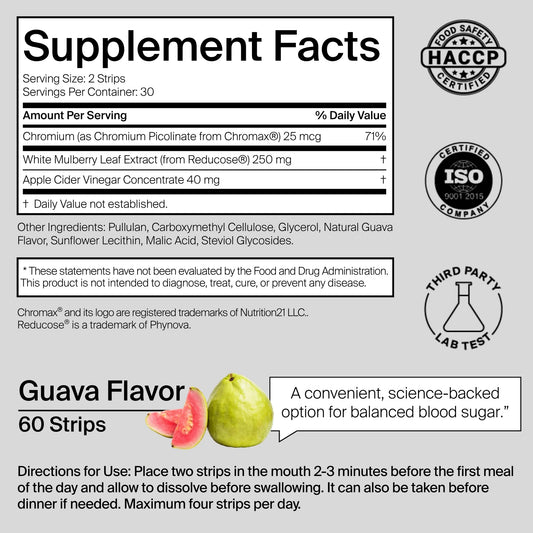
For people exploring strip-format options built around Reducose® at the clinically studied dose, BIOSTRIPS® Glucose Support is one of the formulations to know about. BIOSTRIPS® Glucose Support is a sugar-free oral dissolving strip made with Reducose®, Chromax®, and apple cider vinegar to support healthy glucose metabolism and carb processing before meals. The directions call for two strips placed in the mouth two to three minutes before the first meal of the day, with optional dosing before dinner. Maximum four strips per day.
The Reducose® dose in two strips matches the 250 mg studied in the Lown 2017, Thondre 2021, and Thondre 2024 trials. The Chromax® content provides 71% of the Daily Value for chromium, sitting comfortably within the IOM Adequate Intake range. The strip format dissolves in roughly ten seconds and doesn't require water or preparation, which matters for the only metric that ultimately decides whether a supplement works: whether the person remembers to take it.
|
What this guide does not claim. This guide is educational. It does not claim that any supplement, including BIOSTRIPS® Glucose Support, treats, prevents, cures, or reverses diabetes, pre-diabetes, insulin resistance, or any disease. The clinical research cited here demonstrates effects on post-meal glucose response in healthy adults under controlled study conditions. Individual responses vary. Always consult a qualified healthcare provider before adding a new supplement to your routine, especially if you take medication that affects blood sugar.
Frequently asked questions about white mulberry leaf extract and Reducose®
What is white mulberry leaf extract used for?
White mulberry leaf extract is used in supplements designed to support healthy glucose metabolism and carbohydrate processing, particularly in pre-meal routines. The patented Reducose® form, made by Phynova, is the most clinically studied version of the ingredient.
How does Reducose® work?
Reducose® works in the small intestine. The active compound DNJ temporarily binds to the alpha-glucosidase enzyme that breaks complex carbohydrates down into glucose. The breakdown still happens, just more gradually, which supports a steadier post-meal glucose response. The mechanism is entirely in the gut. Nothing crosses into the bloodstream.
What is the clinically studied dose of Reducose®?
The clinically studied dose is 250 mg per serving, taken co-administered with the meal. Three peer-reviewed randomized controlled trials have tested this dose against placebo, with consistent findings on post-meal glucose response. Formulations that match this dose are the ones with direct clinical substantiation.
Is Reducose® the same as generic mulberry leaf extract?
No. Reducose® is a branded, standardized, and clinically studied version made by Phynova Group Limited. It's standardized to 4.5% to 5.5% DNJ by HPLC and has been tested in multiple peer-reviewed trials. Generic mulberry leaf extracts often don't disclose their DNJ content and rarely have direct clinical research behind the specific extract being sold.
When should you take a mulberry leaf supplement?
Co-administer with the meal. Specifically, take it within a few minutes of eating, not hours ahead. For pre-meal glucose support formulations like BIOSTRIPS® Glucose Support, the standard guidance is two to three minutes before the first meal of the day.
Is white mulberry leaf extract safe?
The Reducose® form has been well tolerated across three peer-reviewed clinical trials at doses up to 500 mg. No serious adverse events were reported, and gastrointestinal tolerability showed no significant differences from placebo. Anyone taking medication that affects blood sugar should consult a healthcare provider before adding a glucose support supplement.
Key takeaways
- White mulberry leaf extract is a botanical extract from the leaves of the Morus alba tree, used in metabolic support supplements.
- The bioactive compound is DNJ (1-deoxynojirimycin), which temporarily occupies the alpha-glucosidase enzyme in the small intestine and supports a more gradual carbohydrate breakdown.
- Reducose® is the patented, standardized, clinically studied form of the extract, made by Phynova Group Limited in the UK.
- The clinically studied dose is 250 mg per serving, tested in three peer-reviewed randomized controlled trials.
- The mechanism happens entirely in the gut. Nothing crosses into the bloodstream.
- Reducose® and Chromax® complement each other in well-designed glucose support formulations.
- Anyone taking glucose-lowering medication should consult a healthcare provider before using a Reducose® supplement.
The mulberry leaf supplement category is one of the few areas in wellness where the science is genuinely strong and the consumer marketing is genuinely confused. The difference between a Reducose® formulation at 250 mg and a generic mulberry extract at an unspecified DNJ percentage is the difference between supplementation grounded in clinical research and supplementation grounded in marketing. For people exploring strip-format options built around Reducose® at the clinically studied dose, BIOSTRIPS® Glucose Support is one of the formulations to know about.
This statement has not been evaluated by the Food and Drug Administration. This product is not intended to diagnose, treat, cure, or prevent any disease.
Reducose® is a registered trademark of Phynova Group Ltd.
Chromax® is a registered trademark of Nutrition 21, LLC.
About BIOSTRIPS®
BIOSTRIPS® is a category-defining brand in oral dissolving nutrient strips, founded in 2019 by Certified Nutritional Advisor Joanna Bacchus. A brand of Elsantis US Inc., BIOSTRIPS brought its first strips to market in 2022 and develops sugar-free, vegan formulations using clinically studied, branded ingredients. Learn more at joannabacchus.com.
Sources
1. Lown M, Fuller R, Lightowler H, et al. (2017). Mulberry-extract improves glucose tolerance and decreases insulin concentrations in normoglycaemic adults: Results of a randomised, double-blind, placebo-controlled study. PLoS One. https://pmc.ncbi.nlm.nih.gov/articles/PMC5321430/
2. Thondre PS, Lightowler H, Ahlstrom L, Gallagher A. (2021). Mulberry leaf extract improves glycaemic response and insulinaemic response to sucrose in healthy subjects. Nutrition & Metabolism. https://pmc.ncbi.nlm.nih.gov/articles/PMC8047566/
3. Thondre PS, Butler I, Tammam J, et al. (2024). Understanding the Impact of Different Doses of Reducose® Mulberry Leaf Extract on Blood Glucose and Insulin Responses after Eating a Complex Meal. Nutrients. https://pmc.ncbi.nlm.nih.gov/articles/PMC11174565/
4. Wang R, Li Y, Mu W, et al. (2018). Mulberry leaf extract reduces the glycemic indexes of four common dietary carbohydrates. Medicine (Baltimore). https://pmc.ncbi.nlm.nih.gov/articles/PMC6113008/
5. UK Nutrition and Health Claims Committee. (2023). Scientific opinion for the substantiation of a health claim on a single component of Morus alba (white mulberry) leaf extract and assisting healthy blood glucose levels. https://www.gov.uk/government/publications/uknhcc-scientific-opinion-white-mulberry-leaf-extract-and-blood-glucose-levels/scientific-opinion-for-the-substantiation-of-a-health-claim-on-a-single-component-of-morus-alba-white-mulberry-leaf-extract-and-assisting-healthy-bl
6. Phynova Group Limited. Reducose® Mulberry Leaf Extract. https://www.phynova.com/products/Reducose®/
7. Nutrition 21. Chromax® Chromium Picolinate. https://www.nutrition21.com/
8. Institute of Medicine. (2001). Dietary Reference Intakes for Vitamin A, Vitamin K, Arsenic, Boron, Chromium, Copper, Iodine, Iron, Manganese, Molybdenum, Nickel, Silicon, Vanadium, and Zinc.